The Sociology of Third Places

Jane’s Walk Ottawa-Gatineau May 6, 2023
Ottawa Architecture Week Sept 30, 2024

This walk is framed around the sociological concept of “third places,” those sites that are neither work nor home. Third places are largely public sites of recreation that nourish and inspire sociability. We’ll be focusing on parks, sport, public art, and community gardens. This walk was developed for an undergraduate course by Sarah Gelbard and Tonya Davidson to explore places where architecture, urban planning, and sociology come together in everyday spaces in Ottawa.

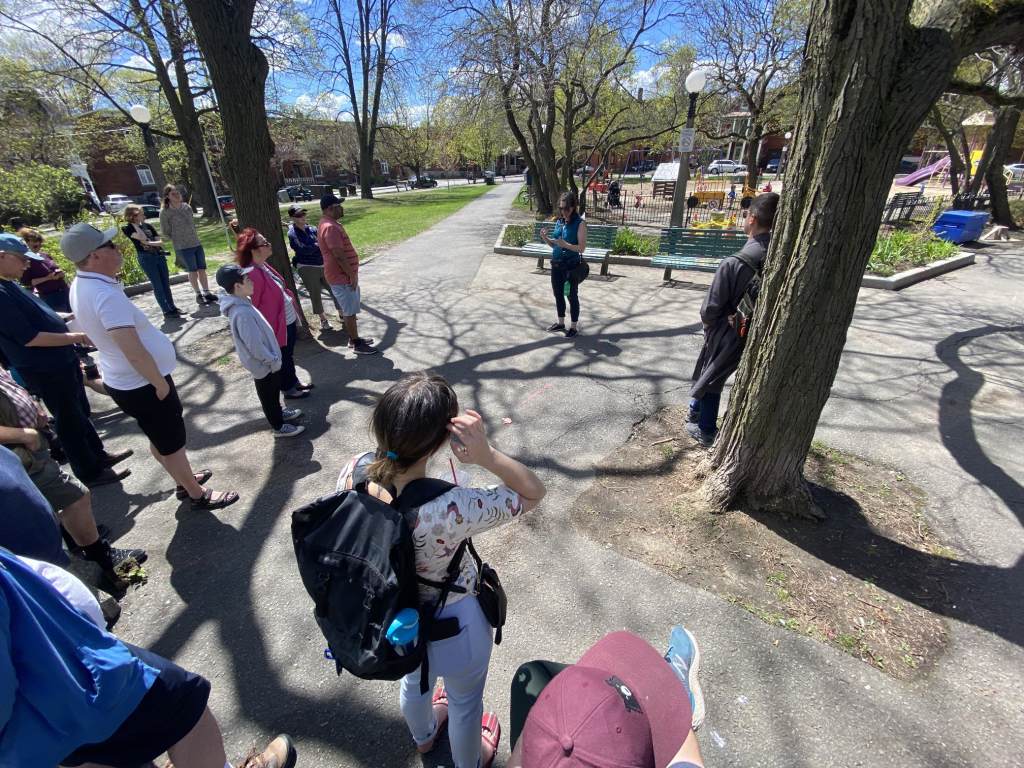
Dundonald Park during our walk in 2023. Photo by Dennis Van Staalduinen
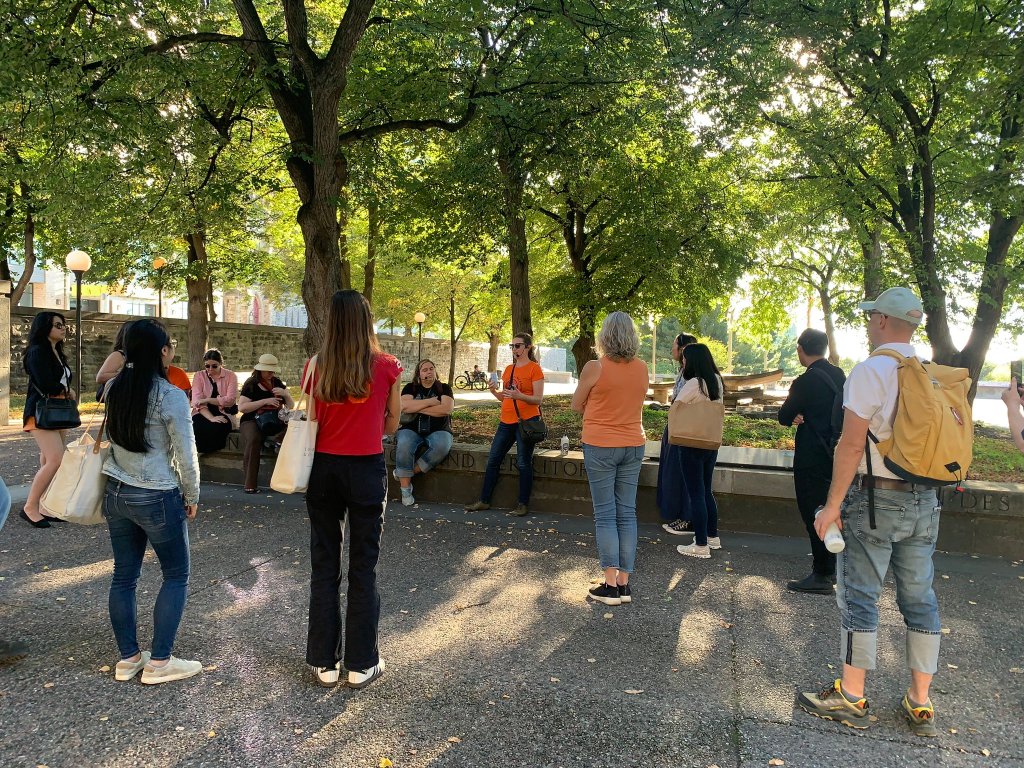
Garden of the Provinces and Territories on our walk in 2024. Photo posted by Siobhan Kirkland on X

Radical Solidarities in Punk and Queer Refusals of Safety and Inclusion Narratives in Planning

Urban Planning Vol 8, No 2 (2023): Queer(ing) Urban Planning and Municipal Governance

Abstract:  Recent call-outs against Ottawa punk venues have fueled public debates about safe space and the inclusivity of local music scenes. The Ottawa Music Strategy released in 2018 translated these debates into cultural development policy that links creative placemaking and safe space discourse. This article examines the civic response to activist call-outs by analyzing how the Ottawa Music Strategy integrates diversity and inclusion strategies into cultural policy, and how cultural policy and safe space policies intersect with cultural revitalization and economic development priorities in the Ottawa Official Plan. Punk counter-narratives developed through grounded ethnographic research in the Ottawa punk scene unsettle normative public safety narratives that frame punk spaces as unsafe. Place-based histories of anti-oppression tactics, logics, and traditions of punk space and activism contextualize alternative responses by local punk venues and promoters. Drawing upon literature in queer planning and queer geography and literature on intersections between radical queer and punk politics, spatialities, and identities, this article discusses punking planning in solidarity with queering planning through alternative community-based responses to issues of safety, inclusion, and participation.

Keywords:  creative placemaking; cultural planning; punk; queer planning; spatial justice

Published:   22 May 2023

DOIhttps://doi.org/10.17645/up.v8i2.6372

“Did You Hear? Mavericks Is Closing!” Punk Refusal of Gentrified Endings

GeoHumanities Volume 9, 2023 – Issue 1 Abstract: Decades of experience with closed, relocated, and renamed venues, make punks very familiar with cycles of gentrification. Often established in edge neighborhoods, punk venues participate in reproducing the “grit” of urban decline and subculture. Urban revitalization plans that promise community, livability, and culture, rarely leave spaces for established punk community and subculture. The newly branded Retail, Arts, and Theatre District in Ottawa, Canada is a case study in cultural urban development that operationalizes creative placemaking and its future-oriented visions of urban revitalization through cultural spaces and activities. Although the city’s Official Plan celebrates that existing cultural venues add diversity to the district, the pressure placed on punk venues by surrounding development reveal that not all venues are to be recognized by the city as legitimate or desirable forms of either diversity or culture. Close readings of official city planning documents, urban histories, development proposals, and marketing literature are juxtaposed with auto-ethnographic, storytelling, punk histories, and song writing. I argue that punk counter-cultural placemaking practices provide counter-information, counter-environments, and counter-temporalities to space in the city to resist gentrification and refuse displacement as endings. Gentrification kills punk. But punk always comes back, finds new places, haunts old sites, and remembers its past. Key Words: creative placemaking, gentrification, punk, revitalization, urban planning Published: 14 Apr 2023 DOI: https://doi.org/10.1080/2373566X.2023.2180418 

Assimilation City: Inclusive Planning and Histories of Exclusion

Canadian Readings of Jewish History: From Knowledge to Interpretive Transmission
D. Maoz & E. Mayer (Eds.)
Cambridge Scholars Publishing

Abstract: Pressing concerns surrounding neighbourhood change, urban inequities, and social movements are burdened with complex histories of exclusion and the complicity of urban planning in reproducing unjust urban landscapes. Ottawa is among the many cities around the world to adopt an “equity and diversity lens” as a tool for tolerance, inclusion, and equity. Within the City’s Official Plan and planning policies, there are pronounced and strange interplays between inclusion and diversity policies and progressive narratives. By tracing the conflation between inclusion and equity in city planning documents and discourse, I reveal how these policies and narrative reinforces normative values and identities of majority groups. By intersecting ontological, theological, and material-spatial analyses, Jewish urban experience unsettles many dominant narratives of place and belonging, whereby place and meaning of place exist in tension with, and in response to, dominant culture. In this paper, I offer a critical autoethnographic case study of looking for and through Jewishness in Ottawa’s urban core. I argue that a deeper interrogation of Jewish histories and experience of and in the city not only offers insights for Jewish cultural studies but might also be placed in meaningful dialogue with other critical urban geographies.

Published: 16 March 2023

ISBN13: 978-1-5275-9003-8

Boycotting the Queers: punk space and/or safe space in Ottawa

Presented at: McGill Queer Research Colloquium

Abstract: A public petition to keep the Queers out of Ottawa is not a news story you expect in 2016. Of course, in this story, the Queers are a touring US punk band from the early 80s and the petition was started by Babely Shades, a collective of artists and activists of colour and marginalized genders. In response to the claims that the show and the band reinforced homophobia and racism in the Ottawa punk scene, the show was cancelled but soon rebooked as a benefit concert for local LGBTQ youth. The story was further complicated when a member of the local opening band Shootin’ Blanx publicly came out as a “proud trans man” in defense of the Queers. Ottawa’s punk scene was left uncertain of what it would mean either to attend or not attend the otherwise highly anticipated show. This paper looks to this incident and surrounding media coverage as a preliminary attempt to disentangle some of the many complex relationships and expressions of resistance, marginal group politics, and counter-public space in Ottawa.

SK8: Urban innovation and governance in the spatial and social design of skateparks

Presented at: Association of American Geographers Annual Conference 2016. San Francisco CA.

Abstract: April 2015: In Montreal, Mayor Denis Coderre legalizes skateboarding in Peace Park. In Ottawa, construction is finally underway on McNabb skatepark. As a means of transportation, recreation, athletic endeavour, and alternative community, skateboarding has a conflictual but undeniable relationship to the city. Though the current trend in city-sanctioned skateparks is often initiated through community grassroots organization, there is a strong reliance on city governance. Whether cities authorize skateparks through deregulation or funding purpose-built construction, the conventionally radical and outsider skate community becomes participant in official processes and control. Continue reading “SK8: Urban innovation and governance in the spatial and social design of skateparks”